As the climate crisis worsens, the fossil fuel industry is promoting carbon pollution dumping or CCS as a way to bury carbon dioxide pollution by pumping it through wells under the ground, including below the ocean floor.
What is carbon capture and storage (CCS)?
Carbon capture and storage – also known as CCS or carbon pollution dumping – is a faulty, unreliable technology that proposes to capture carbon dioxide emissions from polluting industries and inject it deep underground or under the seabed so that it’s not released into the atmosphere, where it causes global warming.
The truth is that carbon pollution dumping projects were never meant to significantly reduce emissions. Many carbon pollution dumping projects today only capture 2-4% of a project’s total emissions when operating at full capacity. However, carbon pollution dumping has a history of failure and underperformance. The latest available data shows that carbon dumping projects are cancelled or put on hold 78% of the time. Projects that do become operational have undershot their capture targets by 20-90%.
Oil and gas companies use CCS to try to offset their carbon emissions. This allows the industry to claim net-zero ambitions, while continuing to extract and burn fossil fuels—worsening the climate crisis and slowing the vital shift to renewable energy. Some fossil fuel companies will also propose converting ageing oil and gas fields to CCS sites to avoid cleaning up their mess in the ocean.
Carbon pollution dumping is an expensive failure, risky at every stage. We must stop offshore carbon dumping in Australian waters from ever happening.
Where is CCS happening in Australia?
In recent years, the Australian Government has offered up vast areas under our ocean to fossil fuel companies for carbon pollution dumping through an annual process known as ‘acreage release’. The areas proposed for CCS include huge areas off the coasts of Western Australia and the Northern Territory, and between Victoria and Tasmania. But despite these acreage releases, offshore carbon dumping has never occurred in Australian waters and should never be allowed to start.
Right now fossil fuel polluter Woodside wants to develop a massive gas and carbon dumping site near Scott Reef, an ancient coral reef system off the north-west coast of Western Australia. Other fossil fuel companies, like BP and Japanese company MIMI (short for Mitsubishi and Mitsui), have partnered with Woodside to turn this fragile ecosystem into an industrial gas zone. This is at a time when the survival of coral reefs and other ocean ecosystems depends on an urgent fossil fuel phase out, not an expansion.
Woodside claims the carbon dumping component of its Browse proposal will help offset its massive carbon emissions. But in reality, it’s a greenwashing distraction that does little but let fossil fuel companies keep polluting and putting our environment at risk.
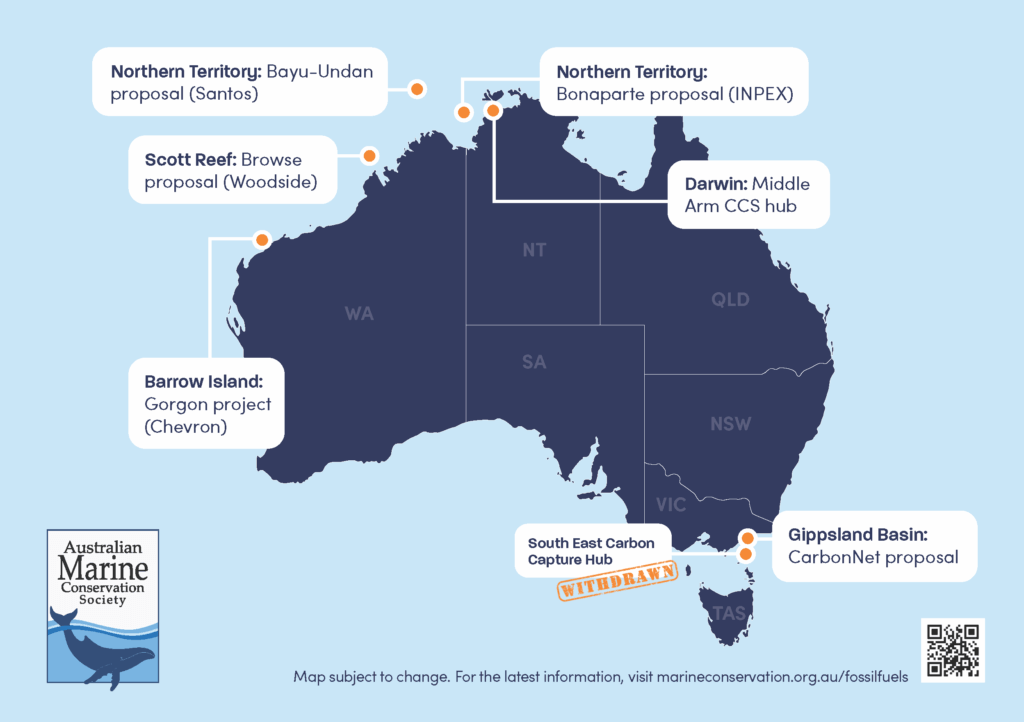
Chevron’s Gorgon CCS project on Barrow Island in Western Australia is an Australian example of CCS failure, where leaking valves, risks of corrosion, and unmanageable pressure buildup have forced Chevron to slow or halt operations, and instead release millions of tonnes of greenhouse gas pollution into the air that it committed to burying below the ocean floor.
The Australian Government must protect our oceans, marine life and climate by ending acreage release for these dangerous CCS projects and not approving any carbon pollution dumping proposals in our ocean, including the Browse CCS proposal.
What are the risks of CCS?
Carbon pollution dumping CCS projects would have alarming impacts on our marine environment and wildlife at every stage, and even long after projects are “finished”. Seismic blasting to map beneath the seafloor is the first step in offshore carbon pollution dumping.
It’s loud, like an underwater bomb, deafening and disorienting whales, turtles, rays and sharks and killing krill and plankton, the food web foundation of ocean life. Seismic blasting continues for many decades after carbon pollution is dumped to monitor the area for leaks, fissures and fractures.
CCS has been a proven failure for decades, and existing offshore carbon pollution dumping projects are rife with problems.
Tens of thousands of Australian ocean lovers have already spoken out against seismic blasting and now’s the time for us to do the same against the threat of carbon pollution dumping, for the sake of the oceans and marine life we love.